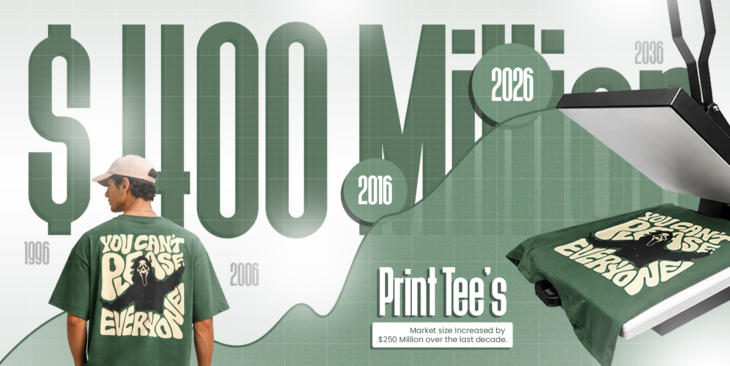
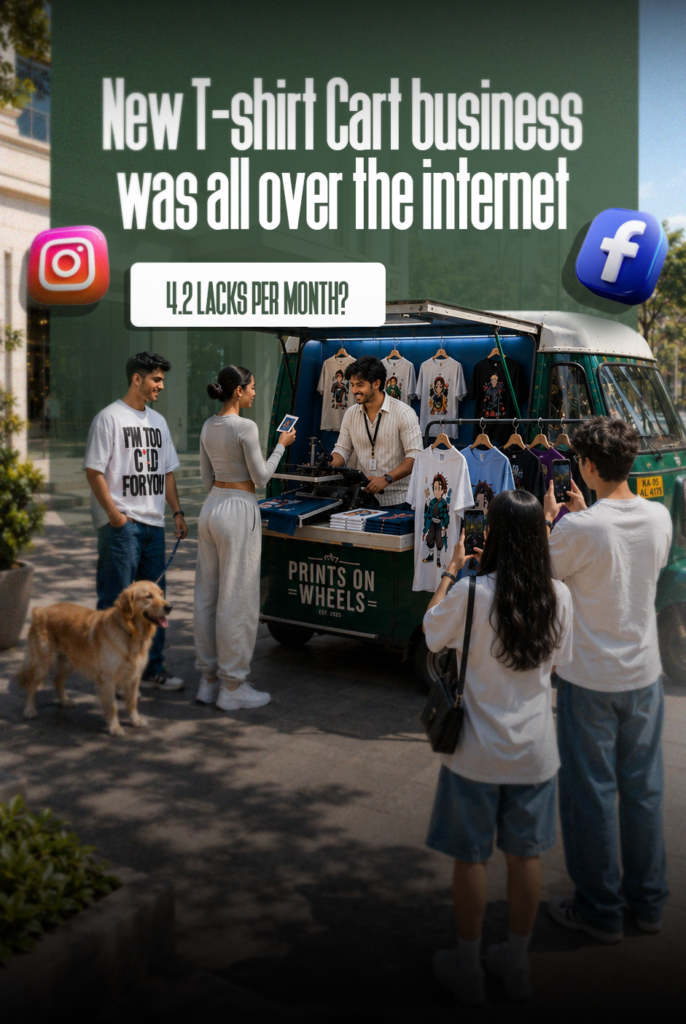
Printed t-shirts are everywhere today. Have you seen that viral reel of a guy selling t-shirts off a cart on a Bangalore street? That guy is Nandan — a 22-year-old who spotted a cart selling ice cream at ₹250 a scoop on Church Street with a line of people waiting, and had one thought — what if that cart sold t-shirts instead?
He went home, got a heat press, designed his own graphics, and parked a cart on the same street. No warehouse. No investors. No big marketing budget. The crowd stopped, bought, and spread the word. Today his brand Untamed Streetwear does ₹40 lakh a month. The most interesting part is not the hustle — it is how little hustle it actually took once he understood what the market already wanted.
That is the real story of printed t-shirts in the last decade. Not a fashion story. A business story.
Printed T-Shirts Made a Business Case That Most People Missed
Printed T-shirts, while everyone was talking about trends and aesthetics, a quieter conversation was happening among resellers, entrepreneurs, and small business owners across India. Printed T-shirts were not just a popular product. They were arguably the smartest low-risk business entry point available.
Printed T-Shirts Made More Business Sense Than Almost Anything Else
Printed T-Shirts: Think about what makes a product business-friendly. Low investment to start. No expiry date. No spoilage. Easy to store, easy to ship, and easy to photograph. Moreover, it works for a single buyer or a bulk order of five thousand. The supply chain does not change as the order size grows. A reseller does not need a shop. A new brand does not need a warehouse. An event company does not need a long-term vendor contract. Because the product works at every level, the entry barrier stays low for everyone. That is what drove the decade-long boom.
Printed T-Shirts Already Had a Market Before the Businesses Even Arrived
Most businesses spend years building demand for their product. However, printed t-shirts skipped that step entirely. The demand was already sitting there built by decades of pop culture, sports, and street identity. Smart businesses simply walked into a room that was already full of people.
Printed T-Shirts Got Free Marketing From Pop Culture for a Decade
Cricket did it first. The 2011 World Cup put printed jerseys and fan tees on every street overnight. IPL took it further city pride, team loyalty, and season after season of fresh demand. Football added another layer entirely. A generation of Indian youth grew up wearing Barcelona and Manchester United tees not as fashion but as identity.
Then came meme culture, regional pride movements, and political campaigns. Furthermore, college fests and social causes kept adding to the pile. By the time entrepreneurs started building businesses around this category, the Indian consumer already knew exactly what they wanted. No education required. No market building needed. Just supply meeting a demand that pop culture had been quietly building for years.
Printed T-Shirts Didn’t Take Over Overnight: The Ground Was Already Being Prepared
Before graphic prints took over, the t-shirt itself was going through its own evolution in India. This matters because it explains why the market was so ready when the product finally arrived at scale.
Branded Logos and Fabric Experiments Prepared the Market First
The branded logo era of the mid-2000s UCB, Levi’s, US Polo, trained Indian consumers to pay a premium for what sits on a t-shirt. That idea planted itself deep. Then came the fabric experiments. Stripes, colour blocks, tie-dye, in-fabric weaves, jacquard patterns, oversized silhouettes — a whole generation pushed the t-shirt in every direction. As a result, by the time affordable digital printing and DTG technology arrived in India, the consumer appetite was already built. The market did not need convincing. It needed a supply.
Reached Every Corner of India When Jio Dropped
In 2016, Reliance Jio launched and rewrote the economics of Indian commerce. Data became nearly free. Smartphones reached Tier 2 and Tier 3 cities at scale. Consequently, a new wave of buyers, sellers, and entrepreneurs entered the market — people who had never had access to this kind of opportunity before.
How Meesho Turned a Simple Product Into Everyone’s First Business
Meesho onboarded millions of first-time resellers almost simultaneously. These were not experienced traders — they were homemakers, students, and first-generation entrepreneurs who needed something simple, reliable, and easy to sell. The answer was the same every time.
Listing a product took minutes. Photographing it needed nothing more than a plain wall. Shipping was light and straightforward. Additionally, low minimum order quantities meant anyone could start without significant capital. So the business grew from the ground up — through millions of small decisions made simultaneously across every city and town in India.
A Pandemic Gave the Category Its Biggest Push Yet
In 2020, the formal wear category collapsed in a matter of weeks. Offices shut. Video calls replaced boardroom meetings. The shirt, the blazer, the formal trouser — an entire wardrobe built over decades — suddenly had nowhere to go. Comfort wear filled the vacuum fast.
The Wardrobe Reset That Formal Wear Never Fully Recovered From
The pandemic did more than shift preferences temporarily. It permanently changed what Indians considered appropriate everyday wear. When offices reopened, the strict formal dress code did not return with the same force. Hybrid work and casual culture took over instead. For businesses already in this space, therefore, the pandemic was not a crisis. It was an accelerator that cleared every competitor out of the way.
Scalability Is the Real Reason It Outlasted Every Trend
Most product categories work well at one scale or another. Few work equally well at every scale. That is the real competitive advantage this category has held for a decade and continues to hold today.
From a Street Cart to a Bulk Order of Five Thousand — the Same Product Delivers
A reseller listing ten designs on Meesho and a corporate HR team ordering three hundred onboarding tees are both buying from the same supply chain. Similarly, a college fest committee ordering fifty pieces and a political campaign ordering fifty thousand are placing the same kind of order. That range — from the smallest buyer to the largest bulk client — is almost unmatched in any other product category. As a result, a business in this space never outgrows its product. It simply moves up the order size. That scalability is what turned a trend into a permanent fixture of Indian commerce.
The Demand Today Does Not Come From One Place — It Comes From Everywhere
The strength of this category is not just volume. It is diversity. The orders come from so many different industries and use cases that no single slowdown can shake the overall demand.
Every Industry Keeps Coming Back to the Same Product
Corporate teams order them for onboarding kits, offsites, and brand merchandise. Event companies depend on them for every fest, marathon, and community drive. D2C brands start with them because the entry cost is low and the margin potential is real. Furthermore, resellers keep them as their anchor product because repeat demand never stops. Sports clubs, gyms, yoga studios, schools, NGOs, and political campaigns — every organised group in India eventually places an order. The category runs on the permanent human need to belong, to express, and to represent. That need does not take quarters off.
Every Printed T-Shirt Needs the Right Manufacturer Behind It
Every reseller listing, every corporate kit, every event tee, and every D2C launch starts with one thing — a manufacturer who delivers on time, at the right price, without cutting corners on quality.
Tackle World has been that manufacturer since 1998. A direct manufacturer and supplier of bulk printed t-shirts based at CB-372, Ring Road Naraina, Delhi — they supply Meesho resellers, D2C brands, corporate buyers, event companies, and sports organisations across India. No middlemen. No inflated pricing. Just direct manufacturing backed by over twenty-five years in the business.
If you are looking to start reselling, scale your brand, or place a bulk order for your next event or corporate need — get in touch directly:
📞 +91-78408 91269 📧 info@tackleworld.in 📍 CB-372, Ring Road Naraina, Delhi 🕗 Monday to Saturday, 8:00 AM – 7:45 PM