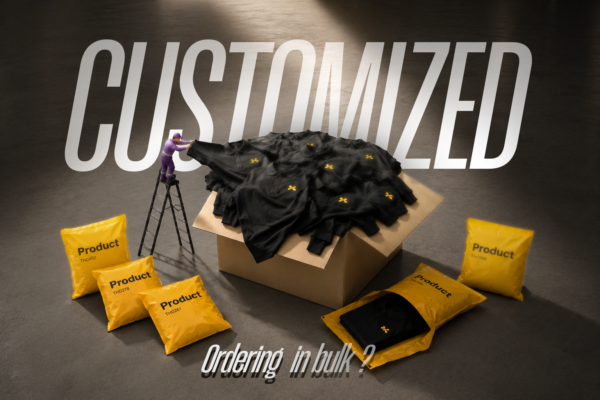
Bulk Ordering · Custom Apparel · Common Mistake
Most reorders are not caused by bad suppliers. They are caused by decisions made before the order was even placed.

Ordering t-shirts in bulk feels straightforward. You pick a size range, submit the numbers, and wait for delivery.
Then the box arrives. The mediums swamp half your team. The XLs look nothing like the sample. And someone quietly mentions the print is already cracking at the collar. You are not looking at a clothing problem. You are looking at a planning problem — and it happened three steps earlier than you think.
These are the three mistakes that cause it.
Mistake 01
Trusting Standard Size Charts Without Collecting Real Measurements
The chart said Medium. The shirt said otherwise.
Every brand sizes differently. A medium from one manufacturer sits two inches narrower in the chest than a medium from another. Furthermore, size charts built for generic retail buyers are not built for a team of thirty people with thirty different body types.
When you order in bulk using only a size chart as your guide, you are essentially guessing. And in bulk, one wrong guess becomes fifty wrong shirts.
A $25 shirt worn zero times costs more than a $45 shirt worn forty times. The reorder is always the expensive part — not the upgrade.
What actually goes wrong
Teams order size distributions based on assumptions — mostly mediums, some larges, a few smalls. But real groups rarely fit that curve. Moreover, unisex sizing runs noticeably different from fitted cuts, and most buyers do not account for that when placing a mixed-gender order.
The fix
Request a physical sample in the exact blank and cut you are ordering. Circulate it. Collect actual preferences. Consequently, your size breakdown reflects real people — not a chart built for someone else’s audience.
Mistake 02
Bulk Ordering One Size Ratio for a Mixed Audience
One distribution curve does not fit every group.
Most buyers submit a single size breakdown for the entire order. It is the simplest approach. It is also the one most likely to leave you with a surplus of sizes nobody asked for and a shortage of the ones everyone needed.
A corporate team of forty looks very different from an event crowd of four hundred. Additionally, a fitness community sizes differently than a creative agency. Treating them with identical ratios is the mistake.
Leftover stock is not a minor inconvenience. It is a direct loss on every shirt sitting in a box — money paid, impression never made.
What actually goes wrong
Buyers apply the same 10% S / 40% M / 35% L / 15% XL formula regardless of who is receiving the shirts. As a result, certain sizes run out on distribution day while others go unclaimed. The brand impression suffers — people either go without or wear something that does not fit.
The fix
Segment your audience before you segment your order. If possible, collect preferences directly. If not, at minimum treat different teams or demographics as separate size pools — and order accordingly. In fact, many suppliers allow split runs with no minimum penalty when planned early.
Mistake 03
Finalising the Print Without Seeing It on the Actual Fabric
What looks sharp on screen often lands differently on cloth.
Print approval is where most buyers take the biggest shortcut. A design is signed off on a screen. The supplier confirms the file. The order goes into production. Then the shirts arrive and the logo is either too large, sits too low, or the colours have shifted entirely from the mockup.
Moreover, different fabrics react differently to the same print technique. A design that pops on a 100% cotton surface can look washed out on a cotton-poly blend using the same ink settings.
Approving a digital mockup is not the same as approving a print. One is a rendering. The other is the actual product. Only one of them ships.
What actually goes wrong
Buyers skip the physical print proof to save time or cost. As a result, placement errors and colour discrepancies only surface at delivery — after the full run is complete. At that point, there is no fix. There is only a reorder.
The fix
Always request a printed strike-off on the exact fabric before approving bulk production. Check placement, colour accuracy, and how the print sits after a wash. Consequently, you are approving what will actually be made — not what it looks like in a PDF.
The Pattern Behind All Three Mistakes
Each one comes from the same place — a decision made too fast, too early, without enough real-world input. The supplier did not fail. The process did.
Bulk orders reward the buyer who slows down at the planning stage. One physical sample, one audience-specific size breakdown, one printed proof — that is the difference between an order that lands well and one that costs you twice.
Get those three things right before anything goes to production. Everything after that is just delivery.
Work With Us?
Ready to Place Your Bulk Order the Right Way?
No back and forth. No guesswork. Just the right guidance from the start.
If this guide helped you see where bulk orders go wrong, the next step is working with a manufacturer who helps you avoid those mistakes before production begins. Tackle World handles bulk t-shirt manufacturing and custom printing — from method selection to final delivery.
Whether you need screen print for volume runs, DTF for detailed artwork, or puff for a textured finish — the right method depends on your fabric, your design, and your order size. Their team will help you figure that out before anything goes into production.
Screen PrintDTFPuff PrintBulk ManufacturingCustom Sizing
Tackle World
Bulk T-Shirt Manufacturing & Custom Printing